Custom Cable Machinery Manufacturing
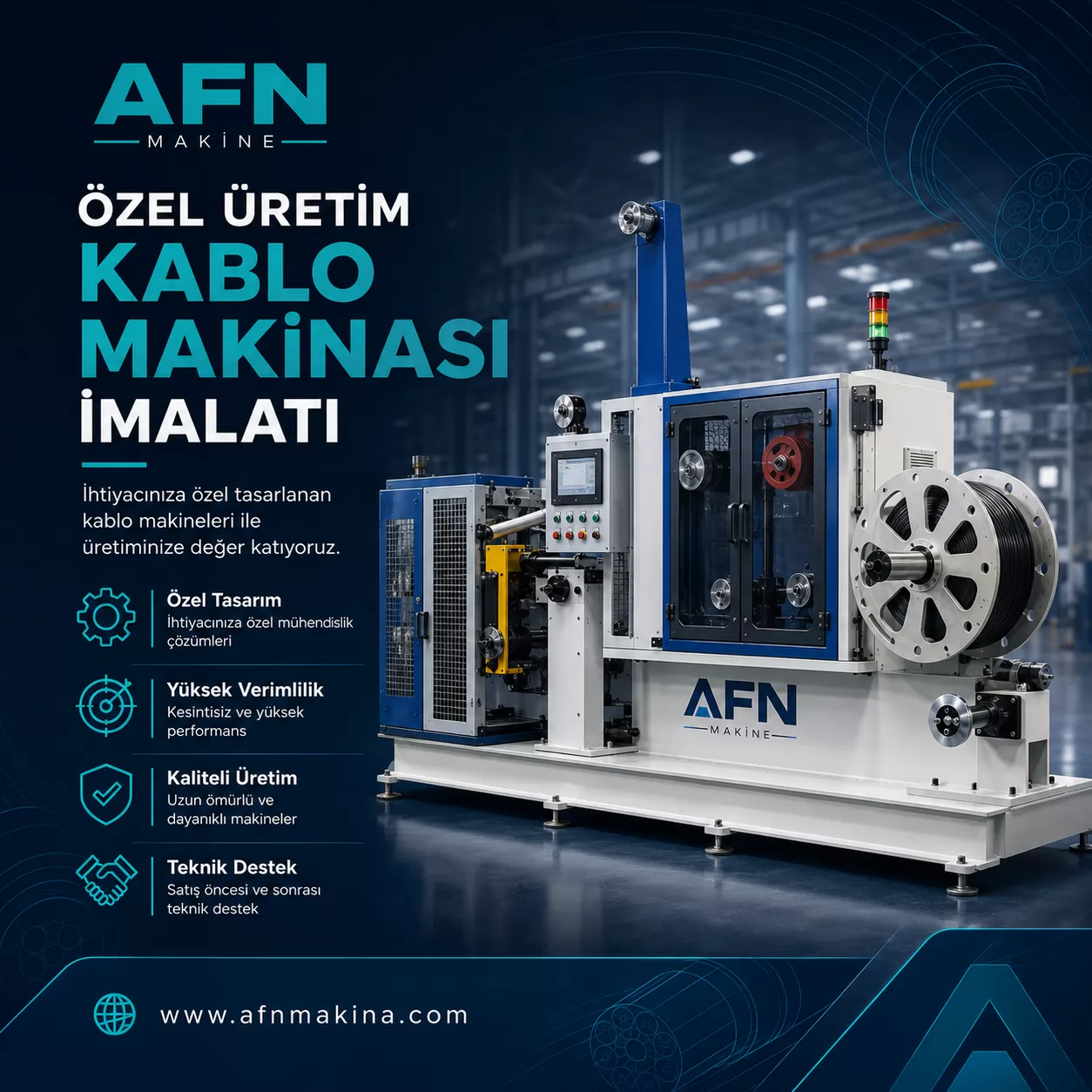
AFN Makina designs and manufactures custom cable machinery tailored to your cable type, production capacity, reel dimensions and plant layout.
Custom Cable Machinery Manufacturing
Every cable factory has different machinery requirements. As the cable construction, conductor cross-section, wire diameter, reel dimensions, target capacity, lay length, operating speed and plant layout change, the technical specifications of the machinery must also change. Therefore, custom cable machinery manufacturing becomes essential for projects where standard solutions are insufficient.
AFN Makina develops custom machinery, auxiliary equipment and complete production lines for the wire and cable industry through its engineering and manufacturing capabilities in Denizli, Türkiye. Every project is evaluated according to the cable type to be produced, the customer's existing machinery, available production space and capacity targets.
The objective is not simply to build a functioning machine, but to develop a safe, efficient, easy-to-maintain and durable system that integrates successfully with the production line.
What Is a Custom Cable Manufacturing Machine?
A custom cable manufacturing machine is designed and manufactured according to the cable producer's specific technical requirements rather than being supplied as a ready-made standard model.
The following parameters can be configured for each project:
-
Wire or cable type
-
Conductor and cable diameter
-
Number and diameter of wires
-
Reel diameter and weight
-
Target production capacity
-
Line speed and twisting speed
-
Direction and length of lay
-
Tension control system
-
Pay-off and take-up configuration
-
Automation level
-
Operator control system
-
Overall machine dimensions
-
Safety equipment
-
Integration with the existing production line
For a detailed comparison, read our article about the differences between standard and custom cable machinery.
Why Is Custom Machinery Needed in Cable Production?
The cable industry includes a wide variety of products. Power cables, control cables, communication cables, automotive cables, flexible cables and special industrial cables may all require different production processes.
One manufacturer may need to twist fine conductors at high speed, while another may require a line capable of handling heavy reels for large-diameter power cables. Some factories have limited floor space. In other projects, the new machine must operate in synchronization with existing pay-off, take-up or transfer equipment.
Custom cable production machinery is especially useful when:
-
Standard machines are unsuitable for the targeted cable type
-
Different reel diameters must be processed
-
A new machine must be added to an existing production line
-
The plant layout is unsuitable for a standard machine configuration
-
Production capacity needs to be increased
-
A special twisting, screening, armouring or taping process is required
-
Operator intervention and production downtime need to be reduced
-
An older production line must be modernised
Which Custom Cable Machines Does AFN Makina Manufacture?
AFN Makina can develop different cable production machines and auxiliary equipment according to the technical requirements of each project.
Buncher Twisting Lines
A buncher twisting line twists wires and fine conductors in a controlled and consistent manner. Different systems can be developed according to conductor cross-section, reel dimensions, target twisting speed and production capacity.
Depending on project requirements, AFN Makina can manufacture buncher machines suitable for reel diameters of 630, 800, 1,250, 1,600 and 2,000 mm. Visit our buncher machine manufacturing page for more information about available reel sizes.
Single Twist Lines
A Single Twist line can be used for twisting, cabling, screening and armouring processes.
Reel capacity, lay length, tension control and automation can be designed according to the cable specifications. Single Twist systems are particularly advantageous for projects requiring production precision and flexibility across different products.
Rigid Stranding Lines
Rigid stranding lines can be used for stranding copper and aluminium conductors, sector shaping, screening and armouring.
The cage configuration, number and dimensions of bobbins, operating speed and line layout can be engineered around the customer's production requirements.
Drum Twister Lines
A drum twister line is used for laying up insulated conductors, power cables and large cross-section multicore cables.
Its robust mechanical structure and adaptable reel systems enable the controlled processing of large-diameter cables. Reel capacity, tension control and automation features can be specified for each project.
Screening Lines
A cable screening line applies metallic screens to medium- and high-voltage power cables and other special cables.
The number of wires, cable diameter, reel arrangement, production speed and tension control system can be customised according to the cable specifications.
Armouring and Taping Lines
Cable armouring lines, which protect cables against mechanical stresses, can be configured for different wire and tape applications.
Cable taping lines apply different tape materials to cables under controlled conditions. The taping head, wrapping angle, tension and operating speed are selected according to the production process.
Pay-Offs, Take-Ups and Auxiliary Equipment
Motorised pay-offs, shaft-type pay-offs, floor-traversing pay-offs, motorised take-ups and floor-traversing take-ups can be manufactured for different reel sizes.
This equipment may operate independently or as an integrated part of a complete cable production line. Caterpillar haul-offs, capstans and transfer systems can also be designed according to cable diameter, pulling force and line speed.
How Does the Custom Cable Machinery Manufacturing Process Work?
Custom cable machinery manufacturing is a comprehensive engineering process that begins with understanding the customer's production requirements.
1. Defining the Technical Requirement
The first stage is to collect technical information about the cable or conductor to be produced. Product diameter, number of wires, material, reel dimensions, target capacity and existing machinery are evaluated.
2. Engineering Analysis
The production process is examined from an engineering perspective. The mechanical structure, drive system, motor power, line speed, tension control and safety requirements are then defined.
Learn more about AFN Makina's R&D and engineering design for cable production machinery.
3. Project Planning and Design
The machine's general configuration and position within the production line are designed. For equipment that will be connected to an existing line, the input and output directions, connection points and synchronisation requirements are considered.
4. Mechanical Manufacturing
Once the project has been approved, the frame, body, shafts, drums, bearing systems and other mechanical components are manufactured.
For further details, visit our page about mechanical manufacturing for cable machinery.
5. Electrical and Automation Systems
Depending on the project, the electrical panel, drives, motor control systems, sensors, safety components and operator interface are prepared.
The purpose of the automation system is to enable the machine to operate safely and consistently at different speeds while remaining synchronised with the production line.
6. Assembly and Testing
After mechanical and electrical assembly, the machine is tested for motion, rotation, tension control, safety and general operation. Compatibility between individual line components is also checked.
7. Installation and Commissioning
Depending on the scope of the project, the machine is installed and commissioned at the customer's facility. Operators are given information about operation, machine settings and basic maintenance procedures.
What Information Is Required for a Quotation?
To prepare an accurate quotation for a custom cable machine, the following information should be provided:
-
Cable or conductor type
-
Minimum and maximum product diameter
-
Number and diameter of wires
-
Material to be processed
-
Reel diameter, width and weight
-
Required production speed
-
Lay length range
-
Direction of lay
-
Technical specifications of existing machinery
-
Dimensions of the available production area
-
Electrical and automation requirements
-
Required safety systems
Technical drawings, product samples, production videos or an existing line layout can help the engineering team evaluate the project more accurately.
Advantages of Custom Cable Production Machinery
A cable machine designed for a specific production process can provide the following benefits:
-
Mechanical construction tailored to the cable product
-
Integration with existing production lines
-
More efficient use of factory floor space
-
Controlled and repeatable production
-
Flexibility for different products
-
Reduced production losses
-
Easier operation
-
Better access to maintenance points
-
Infrastructure suitable for future capacity expansion
-
More consistent product quality
What Should Be Considered When Selecting Cable Machinery?
The initial purchase price should not be the only factor considered when investing in cable machinery. Production capacity, energy consumption, maintenance requirements, automation level, product changeover time and spare-parts availability all affect the total cost of ownership.
Before selecting a machine, cable manufacturers should ask:
-
Which cable types can the machine produce?
-
Can it operate with the existing production line?
-
Can it be adapted for different products in the future?
-
Are maintenance points easily accessible?
-
How quickly can spare parts be supplied?
-
Which systems protect operator safety?
-
Can the manufacturer provide installation and technical support?
When existing equipment has performance or capacity problems, machine overhaul and modernisation may also be considered instead of investing in a completely new machine.
For shafts, bushings, flanges, reels and other specially machined components, AFN Makina also provides cable machinery spare-parts manufacturing.
Why Choose AFN Makina?
AFN Makina approaches cable machinery projects as an integrated process covering engineering, mechanical manufacturing, assembly and testing.
Each solution is developed according to:
-
Cable type
-
Target production capacity
-
Reel specifications
-
Existing machinery
-
Factory layout
-
Automation requirements
In addition to new machinery, project-specific solutions can be developed for auxiliary equipment, modernisation and special spare parts. Explore all available options on the AFN Makina services page.
Let Us Develop a Custom Cable Machine for Your Project
If you are planning to establish a new cable production line, increase your current capacity or commission a machine for a specialised production process, share your technical requirements with AFN Makina.
Your cable type, product dimensions, reel specifications, capacity expectations and existing production line can be evaluated to develop an engineering solution tailored to your project.
Visit the AFN Makina contact page to discuss your project and request a quotation.
Telephone: +90 530 037 90 36
Email: info@afnmakina.com
Address: Hacıeyüplü Mahallesi, 3045 Sokak No:4, Merkezefendi, Denizli, Türkiye
Frequently Asked Questions About Custom Cable Machinery
Does AFN Makina Manufacture Custom Cable Machines?
Yes. AFN Makina can design and manufacture custom cable machinery and auxiliary equipment according to the cable type, reel dimensions, target capacity, plant layout and automation requirements.
Which Cable Machines Can Be Custom-Manufactured?
Buncher, Single Twist, rigid stranding, drum twister, screening, armouring and taping lines, as well as pay-offs, take-ups, caterpillar haul-offs, capstans and transfer equipment, can be customised according to project requirements.
Can a Machine Be Manufactured for an Existing Production Line?
Yes. The technical specifications, operating direction, line speed and connection points of the existing machinery can be evaluated to develop a solution that integrates with the production line.
How Is the Price of a Custom Cable Machine Determined?
Pricing depends on the machine type, capacity, reel dimensions, mechanical construction, automation level, auxiliary equipment and installation scope. Technical requirements must therefore be evaluated before an accurate quotation can be prepared.
How Long Does It Take to Manufacture Cable Machinery?
The manufacturing time depends on the project's technical scope, machine size, automation level and auxiliary equipment. A project-specific delivery schedule is established after the technical evaluation.
Can Cable Machinery Be Manufactured for Overseas Factories?
Yes. Cable machinery and production lines can be prepared for export after evaluating the customer's technical requirements, electrical infrastructure and plant conditions.